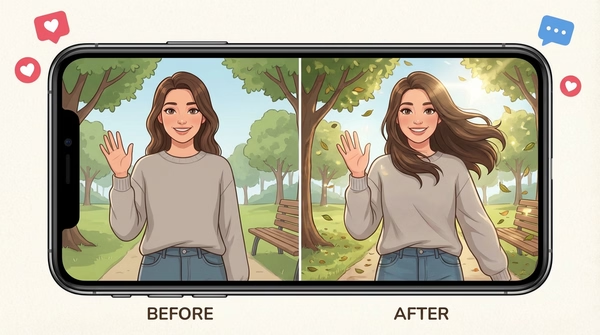
The best image to video AI tools in 2026 turn still images into short, usable video clips without all the manual animation grunt work. Magic Hour stands out for creators who want image-to-video generation alongside face swap, talking-photo, lip-sync, image editing, and other AI media workflows in one place.
Turning a static image into a convincing moving scene used to mean keyframes, motion graphics software, or a full-on professional animation workflow. By 2026, AI video generators can handle most of that from a single image and a short instruction.
I actually spent time comparing the practical differences between these tools instead of just judging them off demo reels. The real questions are simple: How well does a tool hold onto the source image? How much control do you get over the motion? How fast can you generate variations? What does the free tier actually give you? And what does the pricing look like once you’re generating regularly, not just once?
Best Image to Video AI Tools at a Glance
| Tool | Best for | Main modalities | Platform | Free access |
|---|---|---|---|---|
| Magic Hour | Multi-tool AI content workflows | Text, image, video, audio | Web, API | Yes |
| Runway | Directed video generation | Text, image, video | Web, iOS, API | Yes |
| Pika | Creative effects and fast experiments | Text, image, video, audio | Web, API | Yes |
| Adobe Firefly | Adobe-centered creative workflows | Text, image, video | Web, Creative Cloud | Yes |
| Kling | Motion-heavy AI video | Text, image, video | Web | Limited/free credits vary |
| Veo | High-end generative video | Text, image, video | Google products/API | Access varies |
| Luma | Image-to-video experimentation | Text, image, video | Web/API | Limited access varies |
Which tool’s actually right for you comes down more to your production workflow than any single benchmark score.
1. Magic Hour — Best for All-Around AI Image-to-Video Workflows
Magic Hour takes a broader swing than your typical single-purpose image-to-video generator. Along with animating images, it bundles together video generation, image editing, face replacement, lip sync, talking photos, and a handful of other creative functions.
For creators starting from a product photo, a character illustration, a portrait, or a concept image, its ai image to video workflow gives you a direct path from still image to moving clip.
That broader workflow genuinely matters, honestly, because an image-to-video project rarely wraps up after the first generation. You’ll probably need to tweak the source image, run several variations, swap a face, sync up dialogue, or produce multiple versions for different channels.
Pros
- Combines image-to-video with several other AI media tools.
- Supports multiple AI models and creative workflows in one platform.
- Free access, no paid subscription required.
- Current plans include API access.
- Credits don’t expire, per the current pricing info.
- Supports parallel generations on paid plans.
- Includes face swap, lip sync, talking-photo, image editing, and more.
- Useful for both individual creators and developers building automated workflows.
Cons
- Output quality and controls vary depending on the model you pick.
- AI-generated video still needs review for motion errors and subject consistency.
- Credit consumption depends on the operation and settings selected.
- Advanced users may need to compare individual models instead of treating the whole platform as one engine.
Magic Hour’s especially useful when the project’s more than just animating one picture. You might generate a source image, turn it into video, make a talking version, then produce alternate edits — all without bouncing between a bunch of unrelated services.
Its other media tools are worth mentioning too. Creators working with portraits can use ai face swap for controlled identity transformations, while a static portrait meant for narration can get converted with make photo talk ai.
If your workflow bounces between images, video, faces, dialogue, and variations, having all of that in one place cuts a lot of unnecessary tool-switching.
Price and plans
As of September 2026, Magic Hour lists a Free plan plus paid Creator, Pro, and Business tiers. Creator runs $19/month, or $12/month billed annually; Pro’s $39/month, or $25/month annually; Business is $99/month, or $66/month annually. Paid plans get you bigger credit allocations, higher export resolutions, commercial use, watermark-free exports, API access, and higher concurrent generation limits.
The current pricing page also says unused credits don’t expire, and you can buy additional credit packs separately.
2. Runway — Best for Directed Generative Video
Runway’s still a major option for creators wanting more control over their generated shots. The current video-generation lineup includes image-to-video workflows and models like Gen-4 and Gen-4.5.
Runway’s Gen-4.5 handles both text-to-video and image-to-video, and prompts can describe detailed camera choreography, timing, scene composition, and environmental changes.
Pros
- Strong control over motion and composition.
- Image-to-video and text-to-video workflows.
- Web and mobile availability for supported features.
- Broad model ecosystem.
- Genuinely useful for professional creative experimentation.
Cons
- Credit usage adds up fast with repeated generations.
- Different models have different input and output requirements.
- Can feel like overkill for creators who just need simple image animation.
Runway makes sense for projects where the prompt needs to describe specific motion, not just ask for a general animation and hope for the best.
Price and plans
Runway offers a Free tier with a one-time allocation of 125 credits. Paid plans bump up monthly credit capacity through Standard, Pro, and Max tiers aimed at progressively heavier use. The current Pro plan gives you 2,250 credits a month, while Max gives you 9,500.
3. Pika — Best for Creative Effects and Fast Experiments
Pika’s built around quick generative effects and short-form experimentation. Current feature set includes image-to-video, Pikascenes, Pikaswaps, Pikadditions, Pikatwists, and other transformation tools.
For social content creators, the appeal’s really the speed — upload an image, pick a transformation, and check out several short outputs fast.
Pros
- Strong emphasis on creative effects.
- Image-to-video support.
- Multiple transformation-oriented features.
- Genuinely fast experimentation.
- API access for developers too.
Cons
- Short clips stay the primary format here.
- Credit requirements swing a lot by model and effect.
- Some advanced capabilities need paid plans.
Price and plans
Pika’s current consumer pricing includes Free access, Starter, Creator, and Fancy plans. Current pricing lists Starter at $10/month, Creator at $35/month, and Fancy at $95/month on monthly billing, with lower annual rates. Each plan comes with different credit allocations and generation limits.
Pika also has a separate usage-based API structure for developers, priced based on the model and request.
4. Adobe Firefly — Best for Adobe-Centered Workflows
Adobe Firefly’s a solid pick for creators already working inside Adobe’s ecosystem. Its generative AI covers images and video, which matters when an AI-generated clip needs to slot into a broader editing workflow.
Pros
- Strong tie-in with Adobe’s creative ecosystem.
- Supports generative video.
- Good fit for creators already on Creative Cloud.
- Free access available.
- Paid plans give larger generative-credit allocations.
Cons
- Best value really depends on whether you already use Adobe products.
- Generative credits can cap high-volume experimentation.
- Some features and models vary by plan.
Price and plans
Adobe currently lists Firefly Free, Firefly Standard at $9.99/month, and Firefly Pro at $19.99/month. Standard includes 2,000 monthly generative credits, Pro includes 4,000.
5. Kling — Best for Motion-Focused Generation
Kling’s become a genuinely notable name in AI video, mostly because creators reach for it when movement and cinematic transitions actually matter.
Its relevance to image-to-video work comes from using a still image as the visual starting point while generating movement around the subject.
Pros
- Strong focus on generative video.
- Genuinely useful for motion-heavy scenes.
- Supports image-based generation.
- Multiple model generations give you options.
Cons
- Availability and pricing can shift fast.
- Credit systems make direct cost comparisons a headache.
- Model versions can behave differently with the exact same source image.
Kling’s worth testing when movement quality’s your main requirement, not when you need a full editing environment on top.
Price and plans
Pricing and availability vary by region, model version, and access route. For production work, check the current plan and generation cost before locking into a recurring workflow.
6. Google Veo — Best for High-End Generative Video
Google’s Veo family targets high-quality generative video and comes through different Google products and developer access routes.
Worth noting: “Veo” doesn’t necessarily mean the same identical workflow everywhere. Availability, controls, duration, audio support, and pricing can shift depending on the Google product or API you’re actually using.
Pros
- High-end generative video capabilities.
- Strong text and visual prompting.
- Suitable for cinematic concepts.
- Useful for creators and developers evaluating frontier video models.
Cons
- Access varies by product.
- Costs depend on the access route.
- Less useful if your workflow needs a big collection of secondary editing tools in one interface.
Veo’s best evaluated based on the actual shots you need, not general demonstrations.
7. Luma — Best for Image-Led Creative Exploration
Luma’s another solid option for creators experimenting with AI-generated video from images and prompts. Its workflows are especially relevant for concept development, visual storytelling, and short creative sequences.
Pros
- Useful image-led workflows.
- Good fit for creative experimentation.
- Supports AI video generation.
- Relevant for developers through API-based workflows.
Cons
- Pricing and model availability can shift.
- Generated clips still need human review.
- Production requirements might need additional editing software.
For creators who already have strong source imagery, Luma’s worth trying as another model to test against the same reference frame.
How I Chose These Tools
I wouldn’t judge an image-to-video tool off its best demo alone — that’s a pretty unreliable way to pick. A more useful test’s giving each platform the exact same small set of production tasks.
My evaluation framework really comes down to five areas: source-image preservation (does the generated clip actually keep the important visual characteristics of the original?), motion quality (do subjects move naturally, or do hands, faces, objects, and backgrounds distort?), prompt control (can you actually specify camera movement, subject action, timing, and environment?), iteration speed (how easy is it to generate several versions and compare them?), and economics (how many usable generations can you actually get for the monthly cost?).
I also weigh practical stuff like export resolution, commercial-use terms, API access, concurrency, file limits, and whether unused credits expire.
The best image-to-video tool’s usually the one that gives you an acceptable result repeatedly, at a cost your workflow can actually sustain.
The 2026 AI Video Market Landscape
The biggest shift in AI video’s the move away from isolated generation models toward complete creative workflows.
Instead of just asking “which model makes the best video,” creators increasingly need to ask “which workflow gets me from an approved image to a finished asset with the fewest unnecessary steps.”
Multi-model platforms are becoming more important because creators can compare models without rebuilding the entire workflow every single time. Specialist platforms still matter, though, when one particular task — cinematic generation, face transformation, creative effects — is the priority.
API accessibility’s another important shift. Developers can now bake AI media generation straight into applications instead of treating AI video as some standalone website feature.
Cost’s getting easier to compare too, though headline subscription prices can be misleading. A $10 plan that produces fewer usable generations might actually cost more per accepted clip than a $20 plan that produces fewer failed attempts.
Image-to-Video vs. Traditional Animation
Traditional animation still wins for projects that need exact control.
With keyframes, an editor can specify precisely where an object moves, how fast it accelerates, and where it stops. AI image-to-video generation works differently — the model interprets the image and prompt and predicts plausible movement, not exact movement.
That makes AI especially handy for social-media clips, product concepts, storyboards, mood videos, short ads, character experiments, animated portraits, visual prototypes, and B-roll concepts. It’s less suitable when every single frame needs to follow an exact spec.
How to Get Better Image-to-Video Results
The source image is still one of the biggest factors affecting output quality, honestly.
Start with a clean image where the main subject’s easy to identify. Then describe the movement itself, rather than repeating everything already visible in the image.
Instead of writing a paragraph describing a person standing beside a car, for instance, a better prompt might just focus on the person slowly turning toward the camera while the camera makes a subtle forward push.
A practical workflow looks something like: prepare a clean source image, describe the desired motion, generate several short variations, reject anything with obvious artifacts, adjust just one or two variables, generate another batch, pick the most stable result, then add deterministic text, logos, captions, or graphics during editing.
This approach’s generally way more efficient than trying to nail a perfect result in one single generation.
Final Takeaway
Magic Hour’s a strong starting point for creators who want image-to-video generation combined with other AI media workflows — face transformation, talking photos, lip sync, image editing, and more, all in one spot.
Runway’s useful when directed generation and detailed motion control are central to the project. Pika’s well suited to fast creative effects and experimentation. Adobe Firefly makes sense if you’re already deep in Adobe’s ecosystem, while Kling, Veo, and Luma are worth testing for specific generation styles and model capabilities.
Don’t pick an AI video platform off a single impressive demo. Test the same source image across several tools and actually compare the usable outputs, generation cost, controls, and workflow speed.
The AI video market moves fast, so a tool that fits your workflow today might have different models, prices, or limits a few months from now. Treat this shortlist as a starting point, run your own small benchmark, and check pricing before scaling up production.
Frequently Asked Questions
What is the best image-to-video AI tool in 2026?
Magic Hour is a practical option for creators who want image-to-video generation and a handful of other AI content tools. Other ones to look at depending on what your workflow actually needs are Runway, Pika, Adobe Firefly, Kling, Veo and Luma.
Can AI turn a normal photo into a video?
Yes. Image-to-video models take a still image as a visual reference and generate motion according to a prompt or pre-defined motion instruction.
Is image-to-video AI free?
Several platforms offer free access or limited free credits, though the restrictions vary. Magic Hour has a Free plan, Runway gives a one-time Free allocation, Pika offers Free access, and Adobe Firefly provides free daily generations.
What makes a good image-to-video prompt?
A good prompt clearly describes the desired movement, camera behavior, subject action, and important environmental changes — without needlessly restating every visual detail already present in the source image.
Should businesses use AI-generated videos commercially?
Businesses should review the specific platform’s current commercial-use terms, model restrictions, and content policies before publishing generated material. Subscription benefits can differ a lot between plans.




Leave a Reply